Polymer separation
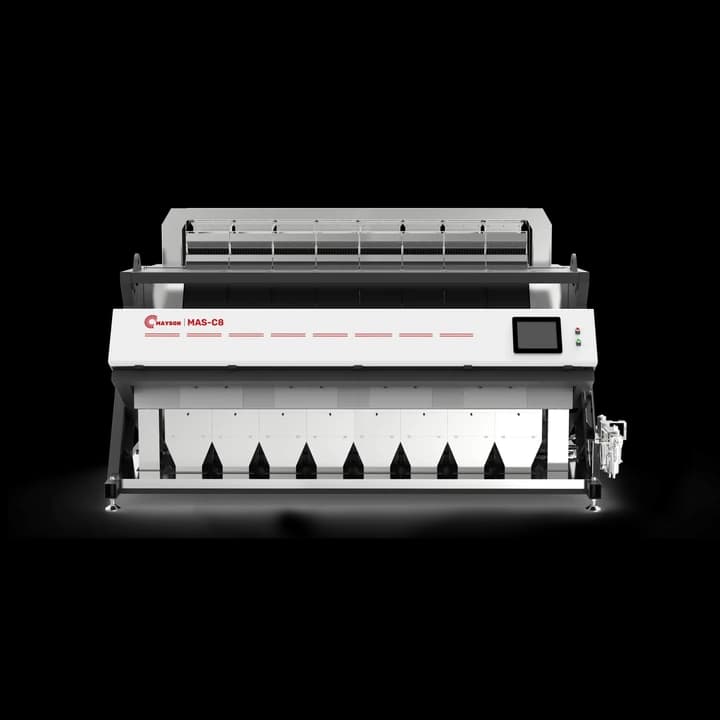
PP and PE cannot be told apart by eye — they share color, transparency and shape. Separating them needs NIR material recognition, which reads each piece's polymer signature rather than its appearance. For prepared flakes that means a multi-spectral sorter such as MAS-P Pro; for whole bottles, MAS-B Pro. Black pieces have to leave first.
Read →
Spectral recognition
NIR sorting identifies what a piece is made of by measuring how it reflects near-infrared light. Every polymer returns a distinct spectral fingerprint across multiple wavelengths, so plastics that look identical to a camera are still separated by material. Each particle is classified and ejected within milliseconds, at production speed.
Read →
PET purification
PVC and PET can be visually indistinguishable, so a color sorter cannot catch it — yet a small fraction of PVC degrades and discolors reprocessed PET. Removing it needs NIR material recognition, which reads the polymer signature instead of the appearance. On washed flakes that is PET flake purification; on whole bottles it happens before shredding.
Read →
A known limit
No. Black and carbon-black plastics absorb near-infrared light, so no usable spectral fingerprint returns and NIR cannot identify their polymer type. Black pieces are removed instead as visible rejects by color sorting, before the material separation runs on what is left. Removing them by color does not identify what polymer they were.
Read →
The core distinction
Color sorting classifies what a piece looks like — color, transparency, shape and visible defects — using visible-light inspection. Material sorting identifies what a piece is made of, using NIR or spectral response. The gap between them is a color-correct piece that is still the wrong polymer, and only material sorting catches it.
Read →
An irreversible fork
Usually both, but the order is fixed and shredding is irreversible. Whole-bottle sorting settles bottle class, color, label condition and — in Pro configurations — material, while those are still readable. Flake sorting then handles color and polymer as staged decisions. Anything decided at bottle level cannot be recovered afterwards.
Read →
Stated limits
Pellets and soft film. Mayson's plastic flake platforms are not designed for pellet sorting, and film, bags and very light flexible plastics cannot be sorted because air-jet ejection cannot reliably control their trajectory. The limit is mechanical rather than a recognition limit — a camera sees film perfectly well.
Read →
Before a quotation
Material that reflects real production rather than a clean selection of it: clear accepted product, the reject classes that actually appear in your stream, and borderline pieces from the edge between them. Size distribution, moisture and contaminant load matter as much as the material name, because they move the decision boundary.
Read →
The mechanism
Six steps, in the same order every time: meter the material into an even flow, present it to the view, illuminate it so the target defect is visible, capture every particle in position, classify accept against reject, and fire a timed air pulse at the rejects. A correct decision still cuts wrong if the timing is off.
Read →
A routine job
They are removed by color sorting, reliably. Wood, metal, stone, rubber and paper look clearly different from the surrounding plastic in color, brightness and surface appearance, and that visible difference is what the camera detects. The result does not depend on polymer type — a wood chip leaves an HDPE stream the same way an off-color flake does.
Read →
Metal recycling
Dual-energy X-ray transmission measures how much X-ray energy passes through each piece, which exposes density and effective atomic-number differences. That separates aluminium from copper, brass, zinc, lead and stainless steel — and because it reads through the piece rather than off its surface, oxidised, dusty or coated scrap is not judged on appearance.
Read →
Food and grain
Visible ones. Yellow and off-colour grains, spotted kernels, chalky grains, broken pieces, dark specks, husk fragments and stones are all separable by visible-light inspection. What cannot be sorted is anything that is not visible: appearance does not confirm the cause of discolouration, and no food-safety diagnosis is implied.
Read →