InsightsAn irreversible fork
Should you sort whole bottles or flakes?
Direct answer
Usually both, but the order is fixed and shredding is irreversible. Whole-bottle sorting settles bottle class, color, label condition and — in Pro configurations — material, while those are still readable. Flake sorting then handles color and polymer as staged decisions. Anything decided at bottle level cannot be recovered afterwards.
What shredding takes away
An intact bottle carries information a flake does not. Bottle class, overall shape, label condition, brand appearance, deformation, and the fact that the whole object is one material — all of it is readable while the bottle is whole, and none of it survives size reduction.
That makes the shredder a one-way door. It is not that flake sorting is worse; it is that the two stages can decide different things, and one of them stops being available.

What each stage decides
| Stage | What it can decide | Platform |
|---|---|---|
| Whole bottles, before shredding | Bottle color, shape, label condition, deformation; bottle material in Pro configurations | MAS-B; MAS-B Pro when material identity is required |
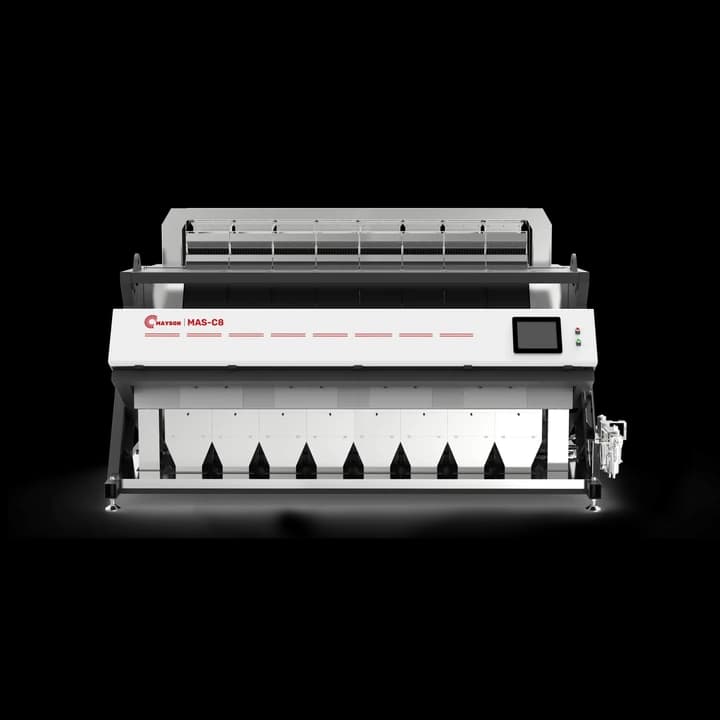
| Prepared flakes, after washing | Visible color and appearance; polymer identity as a separate decision | MAS-C, MAS-P, MAS-P Pro, MAS-PC, MAS-PC Pro |
The standard MAS-B configuration is worth being precise about: it sorts by color and AI-recognized appearance. Separating PET from PP, HDPE and PVC bottles by material needs MAS-B Pro, which adds NIR polymer identification.

Why a full line usually does both
Removing what can be removed while the material is still whole leaves a smaller, cleaner problem for the flake stage. A bottle stage that pulls out the wrong bottle classes means the flake stage is working on a stream that is already closer to the target.
A full recycling line often stages several platforms together rather than choosing one. The question is rarely which stage, but what each stage is being asked to decide.

Where this stops applying
- The standard MAS-B is not a material sorter. Sorting bottles by polymer needs MAS-B Pro.
- Once material is shredded, the whole-bottle route is gone. Bottle-level information cannot be reconstructed from flakes.
- Flake platforms handle rigid flakes, sheets and fragments — not pellets, and not film or soft flexible plastics.
- Neither stage produces food-grade output by itself; that depends on the complete washing, decontamination, extrusion, testing and certification process.
- How much each stage is worth for a given stream is confirmed on a representative sample rather than argued in the abstract.
Common follow-ups
Is bottle sorting or flake sorting better?
Neither replaces the other. They decide different things, and shredding removes the option of deciding at bottle level. A full line commonly stages both.
Can MAS-B sort bottles by material?
The standard MAS-B sorts whole bottles by color and AI-recognized appearance. MAS-B Pro adds NIR polymer identification, so PET can be separated from PP, HDPE and PVC bottles before shredding.
What can be decided on a whole bottle that cannot be decided on a flake?
Bottle class, overall shape, label condition, brand appearance and deformation. All of these are properties of the intact object and disappear when it is size-reduced.
If I sort whole bottles, do I still need flake sorting?
Usually yes, for a different reason. Bottle sorting sets up the stream; flake sorting handles visible color and polymer identity on the prepared material at a resolution the bottle stage cannot reach.
What bottle sizes are covered?
MAS-B sorts whole plastic bottles of roughly 0.5 to 2 L across mixed streams including PET, HDPE, PP, PE, PVC and PS.