
InsightsThe core distinction
What is the difference between color sorting and material sorting?
Direct answer
Color sorting classifies what a piece looks like — color, transparency, shape and visible defects — using visible-light inspection. Material sorting identifies what a piece is made of, using NIR or spectral response. The gap between them is a color-correct piece that is still the wrong polymer, and only material sorting catches it.
Two machines, two questions
Every sorting decision reduces to one of two questions. Does this piece look right? Is this piece made of the right thing? They sound similar and they are not, because a stream can pass one and fail the other.
| Aspect | Color sorting | Material sorting |
|---|---|---|
| Defines quality by | What the piece looks like | What the piece is made of |
| What it reads | Color, transparency, shape and visible defects | Spectral response across the near-infrared range |
| Typical example | Remove green flakes from a clear PET stream | Remove clear PVC from a clear PET stream |
| Cannot catch | A color-correct piece that is still the wrong polymer | Black and carbon-black pieces, which absorb the signal |

Where each one fails
Color sorting fails on the invisible. Clear PVC and clear PET can be visually indistinguishable, so a PVC flake in a PET stream is not a hard detection for a color sorter — it is an impossible one. No amount of tuning changes that, because the difference is not a visible property.
Material sorting fails on the black. Carbon black absorbs the near-infrared signal, so a black piece returns nothing to match. It also has nothing useful to say about a wood chip or a metal fragment: NIR identifies polymers, and a foreign object is a job for the camera.

Which one your quality actually needs
Start from the definition of your accepted product rather than from the machine. If the buyer of your output rejects it for looking wrong — off-color, opaque, black specks — the boundary is visible and color sorting is the direction. If the buyer rejects it because the recyclate degrades or discolors in processing, the boundary is material.
The trap is a stream where both matter and only one is checked. A PET flake stream cleaned to a perfect color window can still carry the PVC that ruins the batch, because the two failures are independent.
When a line needs both
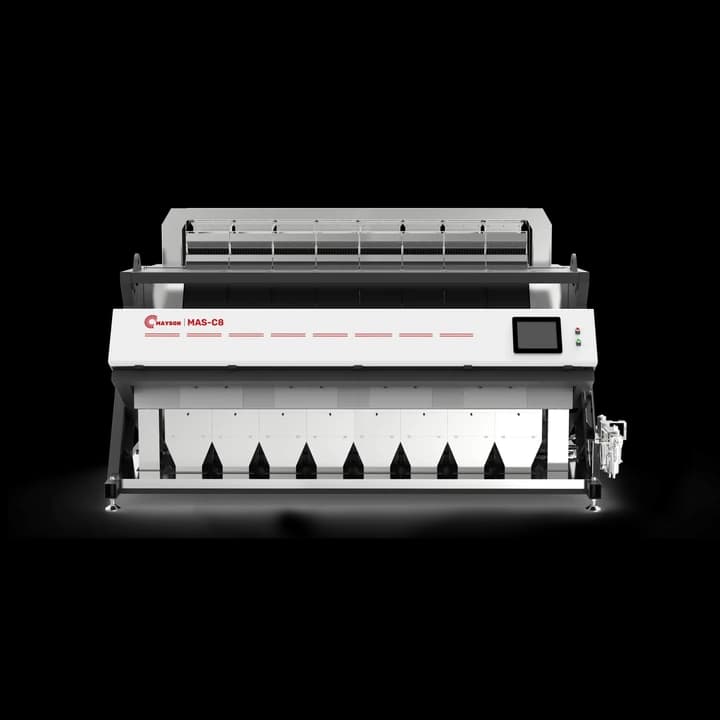
Often it does. There are two ways to arrange it: stage two machines in sequence, or use a combined configuration that makes both decisions on the same pass — MAS-PC for PET material plus color, MAS-PC Pro when the polymer separation is the harder kind.
Which is right depends on the project rather than on a rule. And the order matters when black is present: the color decision comes first, so the material stage is not asked to read pieces it cannot read.

Where this stops applying
- A color sorter cannot be configured to identify polymer type. PET and PVC can look identical, and that is not a tuning question.
- NIR cannot reliably identify black or carbon-black plastics, and is not the route to removing wood, metal, stone or other non-plastic foreign objects.
- MAS-P is PET-focused: its decision is PET vs non-PET, not PP vs PE within the reject fraction.
- Neither route makes output food-grade on its own. That depends on the complete washing, decontamination, extrusion, testing and certification process.
- Which combination a stream needs is confirmed on a representative sample, not from the material name.
Common follow-ups
Can one machine do both color and material sorting?
Yes, in a combined configuration. MAS-PC pairs MAS-P PET purification with MAS-C color sorting; MAS-PC Pro pairs MAS-P Pro polymer separation with color sorting. Staging two machines in a line is the alternative.
Which comes first if a line needs both?
Usually color. Removing black and obviously off-class pieces first means the material stage is not being asked to identify pieces that absorb the NIR signal.
Is optical sorting the same as color sorting?
Not quite. Optical sorting is the broader idea of inspecting every particle in flow and ejecting what does not belong. Color sorting is the version that decides on visible appearance; NIR material sorting is the version that decides on polymer.
Can color sorting remove PVC from PET?
No. Clear PVC can look almost identical to clear PET, so it passes a color decision. Removing it needs NIR material recognition.
Can material sorting remove wood, metal and stone?
That is not its job. Those foreign objects look clearly different from the plastic around them, which is exactly what color sorting detects. NIR is for polymer decisions.