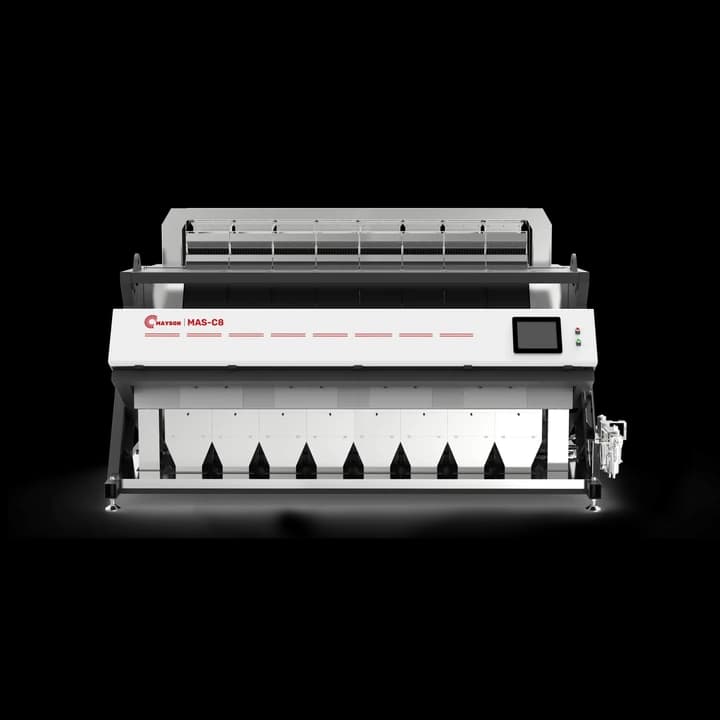
Whole bottles
Post-consumer bottles before shredding, with caps, labels, color and deformation still in the stream.
Buyer's Guide
Don't start from a machine name. Start from what you're sorting and the result you need — then match it to the MAS platform that fits, and prove it on your own material.
How the material arrives at the sorter decides the platform before anything else.
Post-consumer bottles before shredding, with caps, labels, color and deformation still in the stream.
Washed or unwashed plastic flakes and rigid pieces that have already been size-reduced.
Recycled glass cullet that needs color recovery and removal of ceramics, stone, porcelain and metal.
Aluminum scrap, Zorba-type streams and complex metal residues (ASR, IBA, e-waste) sorted by material density with XRT.
Rice, beans, seeds and nuts sorted by visible color, shape, size and foreign material.
What separates an accepted piece from a rejected one — color, material, or shape and foreign material?
Separate by visible color, transparency, surface staining or discoloration — keep the clean fraction, reject off-color or off-class pieces.
A color-correct piece can still be the wrong material — PVC hiding in clear PET, or ceramic in glass. You need to remove non-target material a visible check cannot catch.
Broken, deformed or undersized pieces plus stones, husk, shell, metal and other non-target objects that have to leave the stream.
For metal, color is not enough. Dual-Energy X-ray transmission reads density and effective atomic number to split aluminum from dense heavy metals; FR-XRT Pro adds RGB for complex streams.
Mayson platforms cover plastic, glass and food & grain streams. Find the row that matches your input and boundary.
| Platform | Input form | Sorting boundary | Typical targets | Link |
|---|---|---|---|---|
| MAS-BWhole-Bottle Sorter | Whole bottles (pre-shred) | Material + color + condition | PET vs non-PET, color class, labels and deformation | View MAS-B |
| MAS-CPlastic Color Sorter | Prepared flakes | Visible color | Clear / light / single-color accepted; off-color, opaque, black rejected | View MAS-C |
| MAS-PPET Material Sorter | PET flakes (post-wash) | Material (polymer) | Remove PVC, PE, PP and other non-PET from PET | View MAS-P |
| MAS 3DPolymer Sorter | Mixed rigid flakes | Material + color | Separate PP, PE, ABS, PS, PC, PMMA and color classes | View MAS 3D |
| GlassGlass Recycling Sorter | Crushed cullet | Color + contaminant | Flint / amber / green / blue recovery; ceramic, stone, porcelain and metal removal | View Glass |
| Platform | Input form | Sorting boundary | Typical targets | Link |
|---|---|---|---|---|
| FR-XRTXRT Sorting Series | Coarse aluminum-rich scrap | Material density (Dual-Energy XRT) | Upgrade aluminum; remove copper, brass, zinc, lead and stainless steel | View FR-XRT |
| FR-XRT ProXRT + RGB Fusion Series | Complex mixed metal streams | Density (XRT) + appearance (RGB) | Recover metals from ASR, IBA, heavy non-ferrous and e-waste; reject non-metals | View FR-XRT Pro |
| Platform | Input form | Sorting boundary | Typical targets | Link |
|---|---|---|---|---|
| MAS RGRice & Paddy Sorter | Milled or paddy rice | Color + shape + foreign material | Yellow, chalky and broken grain; stones, husk and foreign material | View MAS RG |
| MAS ASBeans & Seeds Sorter | Beans & seeds | Color + shape + surface | Discolored, spotted and shriveled pieces; foreign material | View MAS AS |
| MAS NNuts Sorter | Kernels & in-shell | Color + shape + foreign material | Shell fragments, broken pieces, color defects and foreign material | View MAS N |
Sorting a full plastic recycling line? See how the four plastic platforms fit one stream, or browse all products.
Before you commit, confirm the result on your own samples — accepted, rejected and borderline pieces.
A representative test turns a shortlist into a verified configuration. Send accepted classes, the rejects you need removed, and any borderline or contaminated examples from your line.
Decide before you size-reduce. If you still have whole bottles, MAS-B classifies them before shredding so contamination never enters the flake stream. If the material is already flaked, look at MAS-C, MAS-P or MAS 3D.
If a visible color check defines your quality, MAS-C is enough. If color-correct pieces can still be the wrong polymer — for example PVC hiding in clear PET — you need material sorting with MAS-P, or MAS 3D when both matter.
For metal, color is not enough. FR-XRT uses Dual-Energy X-ray transmission to upgrade coarse aluminum and remove copper, brass, zinc, lead and stainless steel (Zorba, remelter feed, building aluminum). For complex streams such as ASR, IBA, heavy non-ferrous or e-waste, FR-XRT Pro adds RGB imaging so density and appearance are reviewed together.
The same logic applies beyond plastics. Rice, beans, seeds and nuts sort on color, shape and foreign material with the MAS RG, MAS AS and MAS N platforms; recycled glass cullet sorts on color and contaminants with the Glass Recycling Sorter.
Yes. Final capability depends on your material, color overlap, additives, contamination, and the selected configuration. A representative sample test finalizes the sorting route and machine setup.