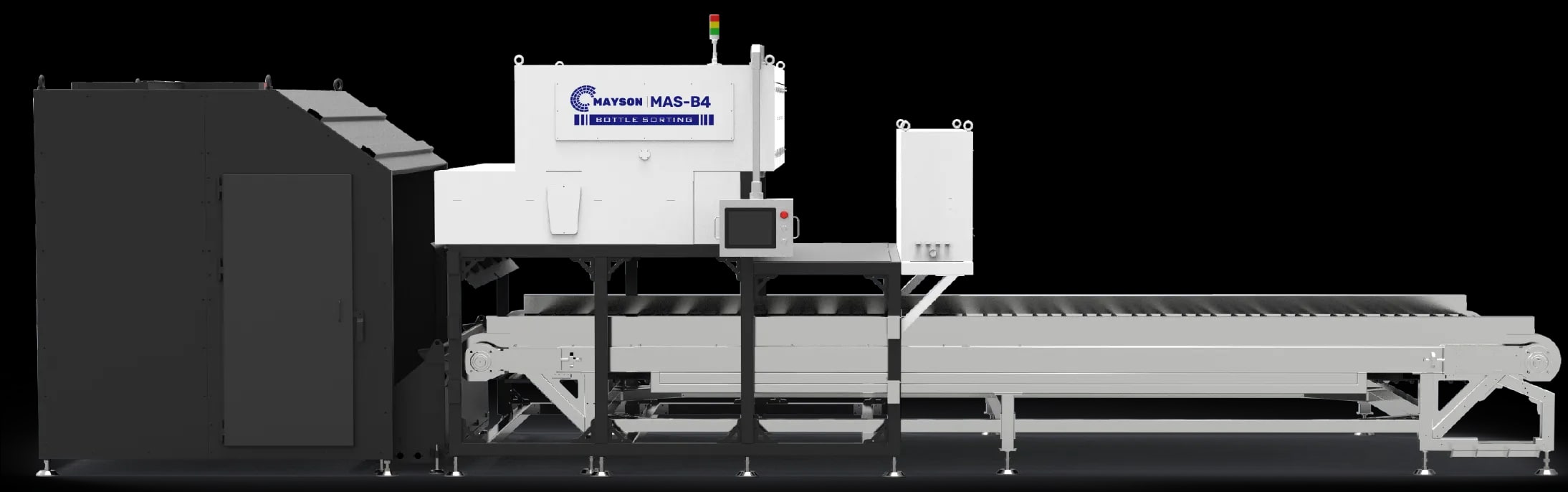
MAS-BBOTTLE SORTING SERIES
Whole-Bottle
Sorting Before
Shredding
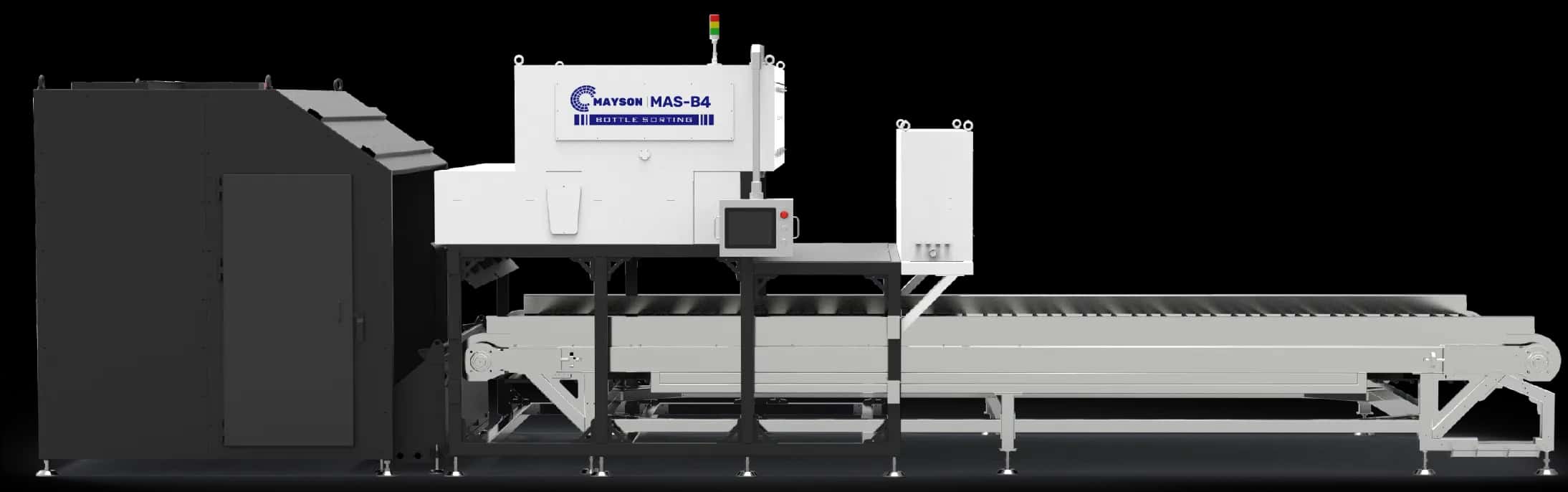
The MAS-B Series sorts complete plastic bottles before shredding — PET, HDPE, PP, PE, PVC, PS and mixed household bottle streams. It classifies bottles by visible color, shape and label / brand appearance; MAS-B Pro adds NIR material recognition for mixed-material bottle streams.
Whole Bottles OnlyBefore ShreddingColor / AI appearance / Material (Pro)Upstream of Flake Processing
01
Feed
Whole bottles conveyed in original form.
02
Inspect
Read color, shape, label and bottle class; material recognition in Pro configurations.
03
Classify / Eject
Accurately separate accepted fractions and reject streams before shredding.
Why MAS-B
Make bottle-level decisions while you still can.
MAS-B sorts whole bottles before shredding, when bottle color, material direction, label and shape are all still readable.
Sort whole bottles, before shredding
Make routing decisions while bottle-level information is still visible, not after everything becomes mixed flakes.
Cleaner downstream routing
Send target bottle classes to the right washing, grinding and flake-preparation path from the start.
Class by color, appearance & condition
Bottle color, shape, label coverage and deformation are reviewed together against your classes; material recognition is available in Pro configurations.
Real-sample configuration
Built from your actual accepted and off-class bottles, including labeled, capped and crushed examples.
Earlier off-class removal
Pull non-target bottles out before they are shredded into a harder, lower-value flake mixture.
Existing-line friendly
Feed, spacing, reject outlets and downstream handoff are planned around your current line.
Main applications
Sort bottles before they become flakes.
MAS-B is positioned by the bottle decision you need to make early, while bottle-level information is still visible and useful.
Application 01
Pre-shredding bottle routing
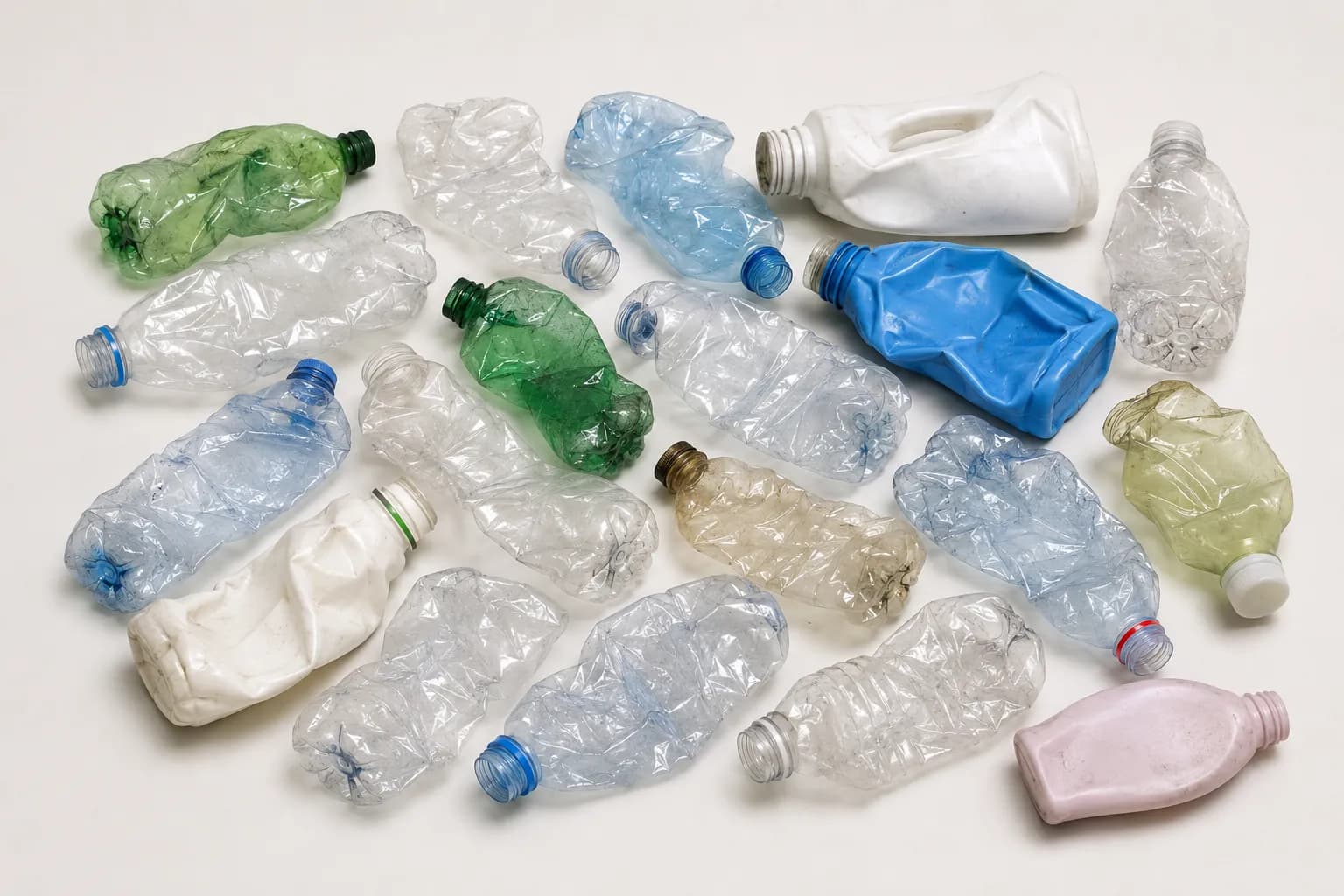
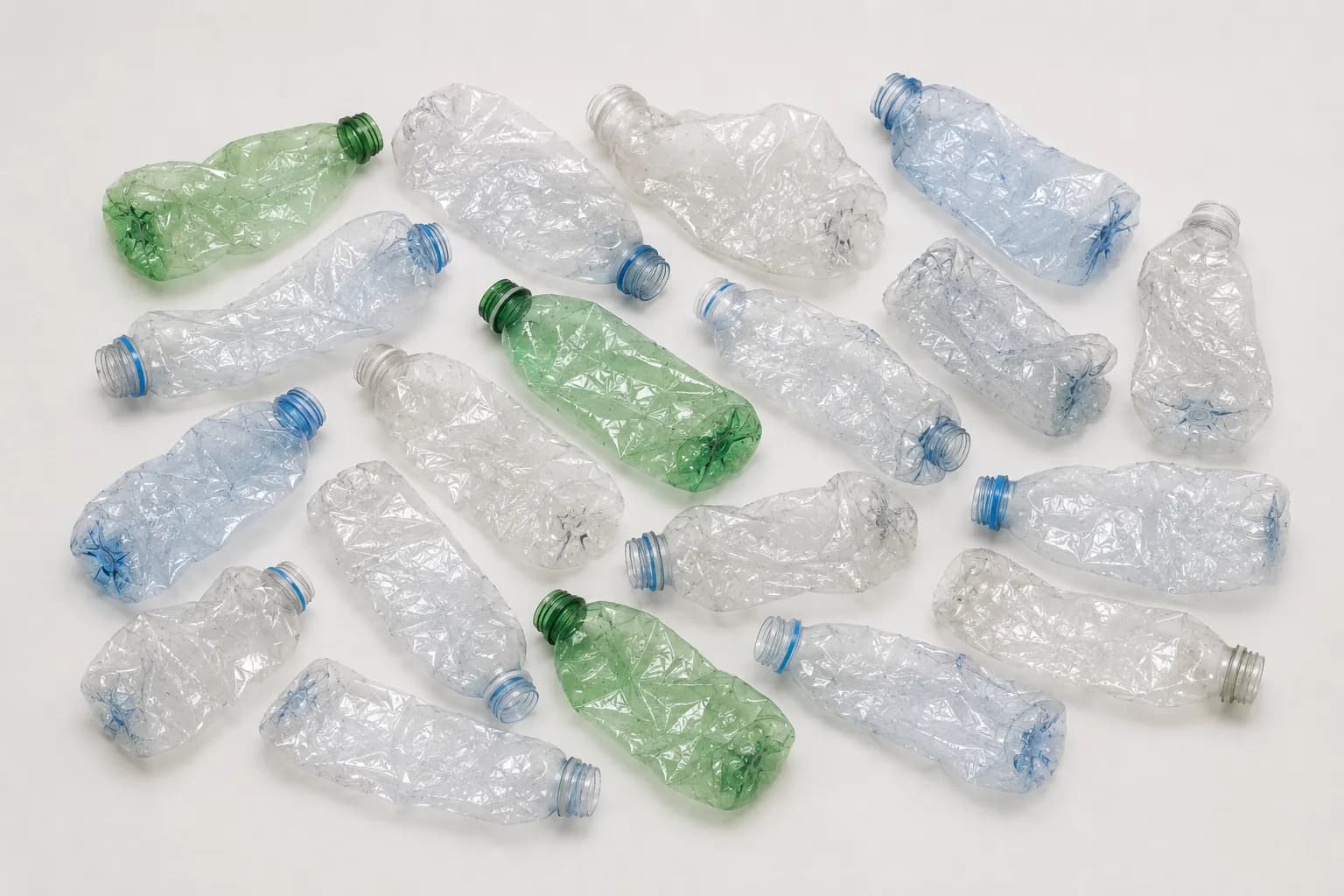
Sort mixed bottle intake while it is still whole — route target bottles to the right downstream path before shredding turns everything into a harder flake mixture.
Mixed intakeCompressed bottlesLabeled / unlabeledPre-shred
Application 02
Bottle-class routing across materials
Route bottles by class — clear and mixed-color PET, HDPE, PP and other bottle families, or a selected PE stream — all defined by your real bottle classes. Material direction is available in Pro configurations.
Clear / mixed PETHDPE / PP bottlesOff-class rejectPE recovery
Sorting scope
What plastic bottles can MAS-B sort?
MAS-B sorts complete plastic bottles before shredding, by visible color and AI-recognized appearance. MAS-B Pro adds NIR material recognition for mixed-material bottle streams.
MAS-B can sort
- PET beverage bottles — water, soda, juice, tea
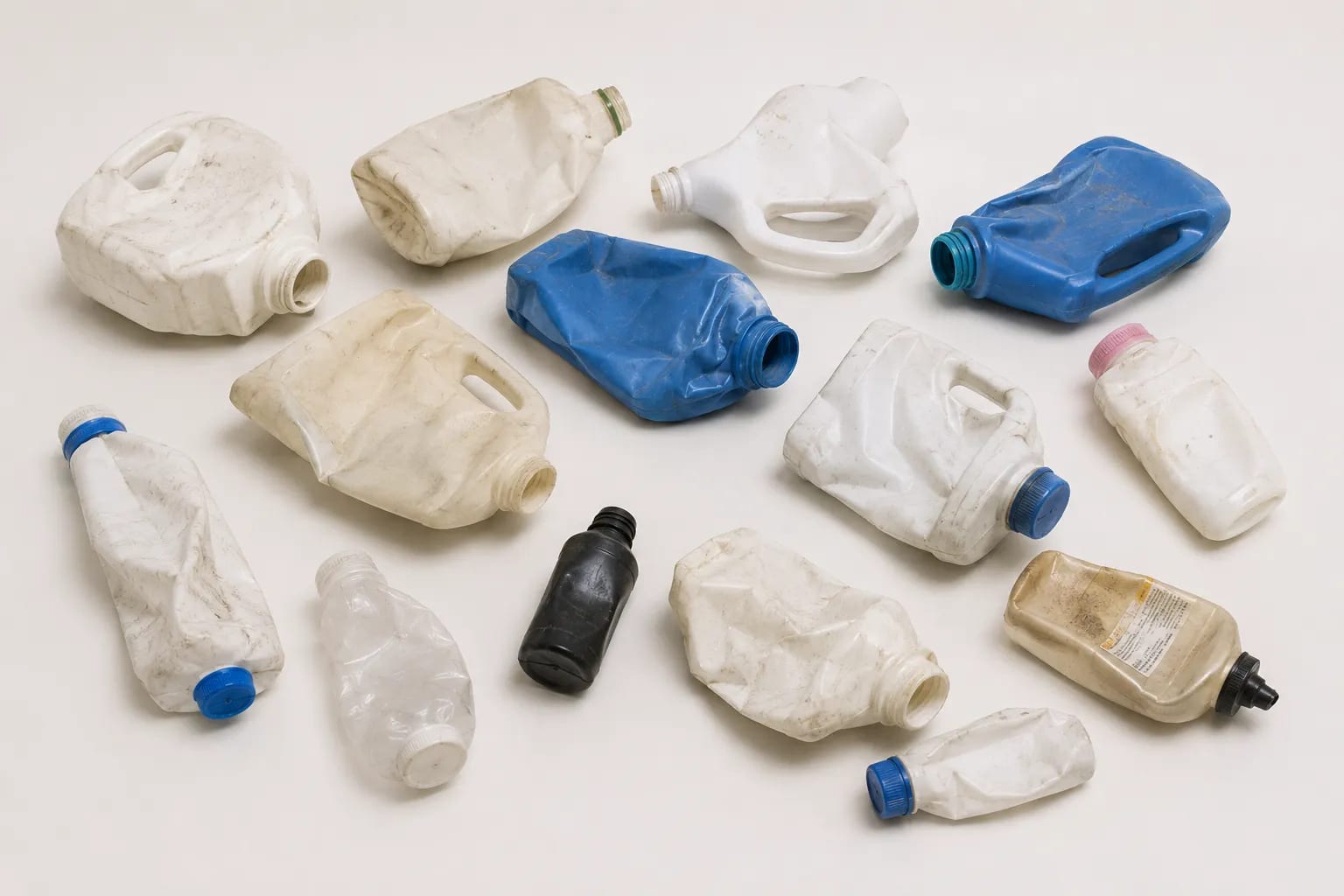
- HDPE milk, detergent and household-chemical bottles
- PP shampoo, cosmetic and personal-care bottles
- PE, PVC and PS bottles where applicable
- Clear, blue, green, amber, white, black and mixed-color bottles
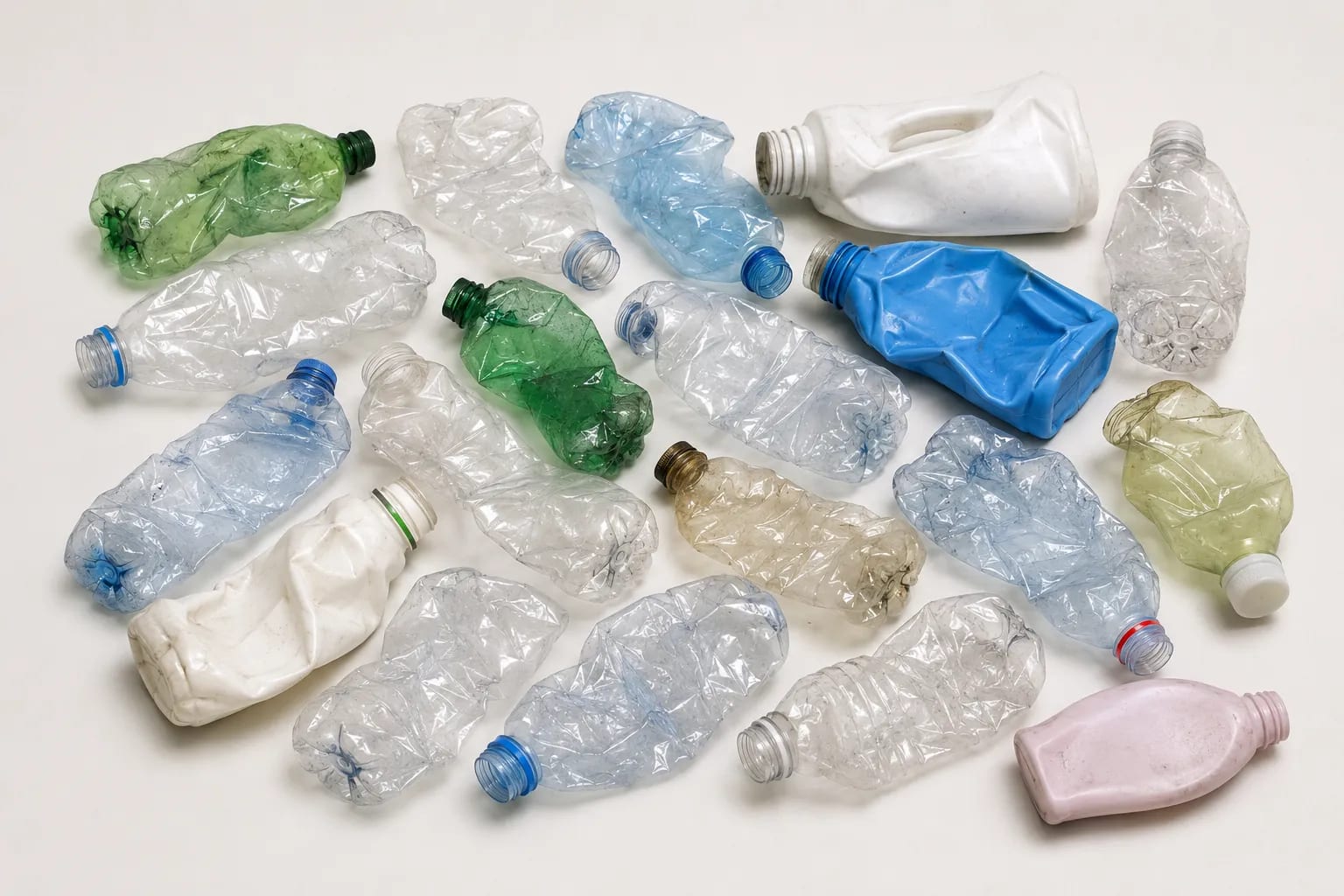
- Labeled, unlabeled, capped, compressed or deformed bottles where presentation allows
- Brand-specific bottles after AI training
- MAS-B Pro adds material sorting — PET vs HDPE / PP / PE mixed-material streams
MAS-B is not for
- Crushed plastic flakes — use MAS-C / MAS-P / MAS-PC
- Plastic pellets — bottle-handling limitation
- Soft plastic film or bags — air ejection is not suitable
- Unknown bottle classes — confirm by sample testing first
- Very small or very large bottles — confirm case by case
Positioning
Is MAS-B only for PET bottles?
No. MAS-B is a whole plastic bottle sorting platform for mixed bottle streams — PET, HDPE, PP, PE, PVC, PS and other complete plastic bottles. Standard MAS-B sorts by color and AI-recognized appearance (shape, label, brand); MAS-B Pro adds NIR material recognition so mixed-material bottle streams can be separated by polymer before shredding.
Whole-bottle stream
Bottle feed, accepted bottles and off-class rejects.
MAS-B decisions start before shredding. Bottle color, material direction, label condition and deformation should be represented in the sample set.
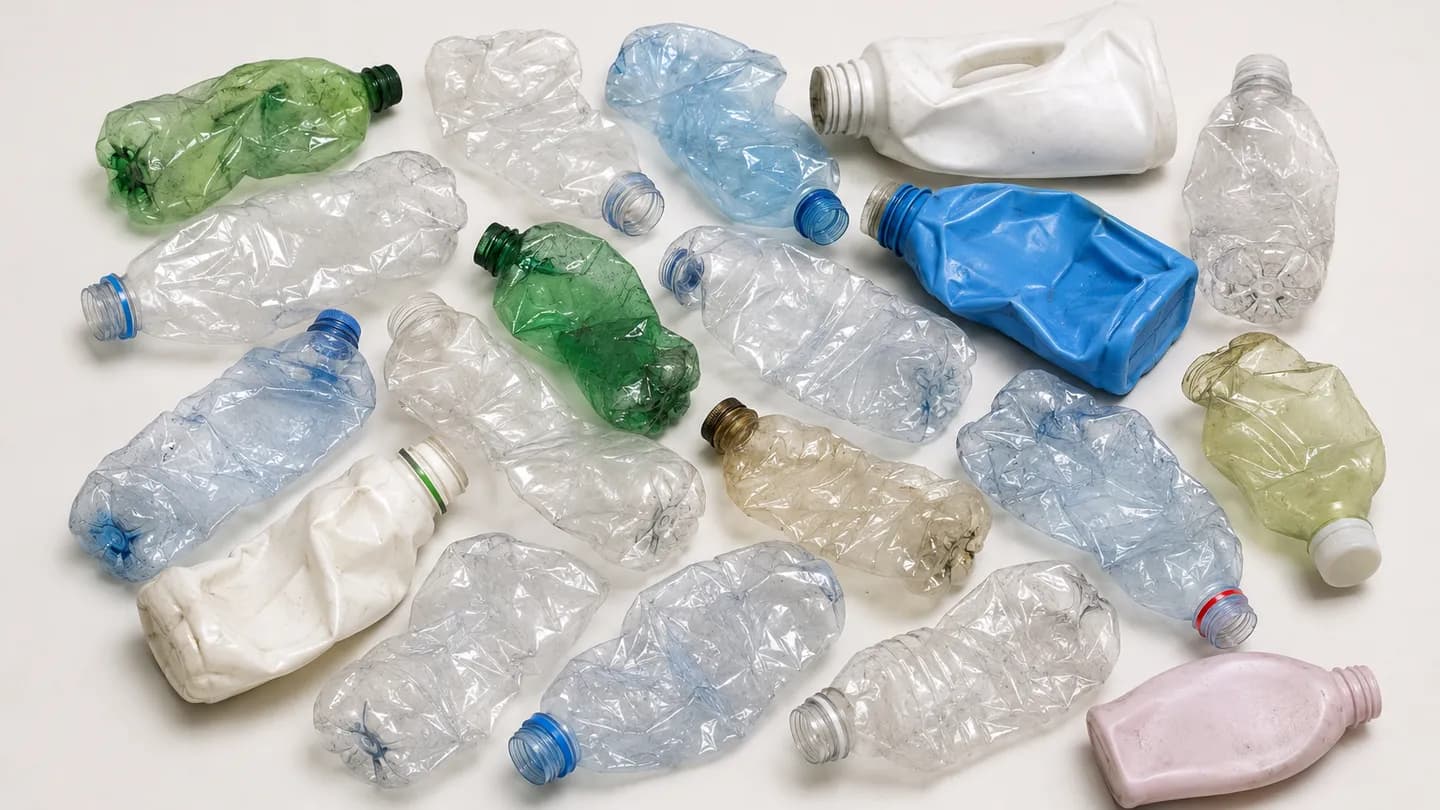
Visual examples are illustrative. Bottle sorting results depend on the material, presentation, selected configuration and operating conditions.
Raw materials
Bottle classes MAS-B is built to separate.
Switch between bottle families and click any class to see the feed, the accepted bottle stream and the off-class rejects.
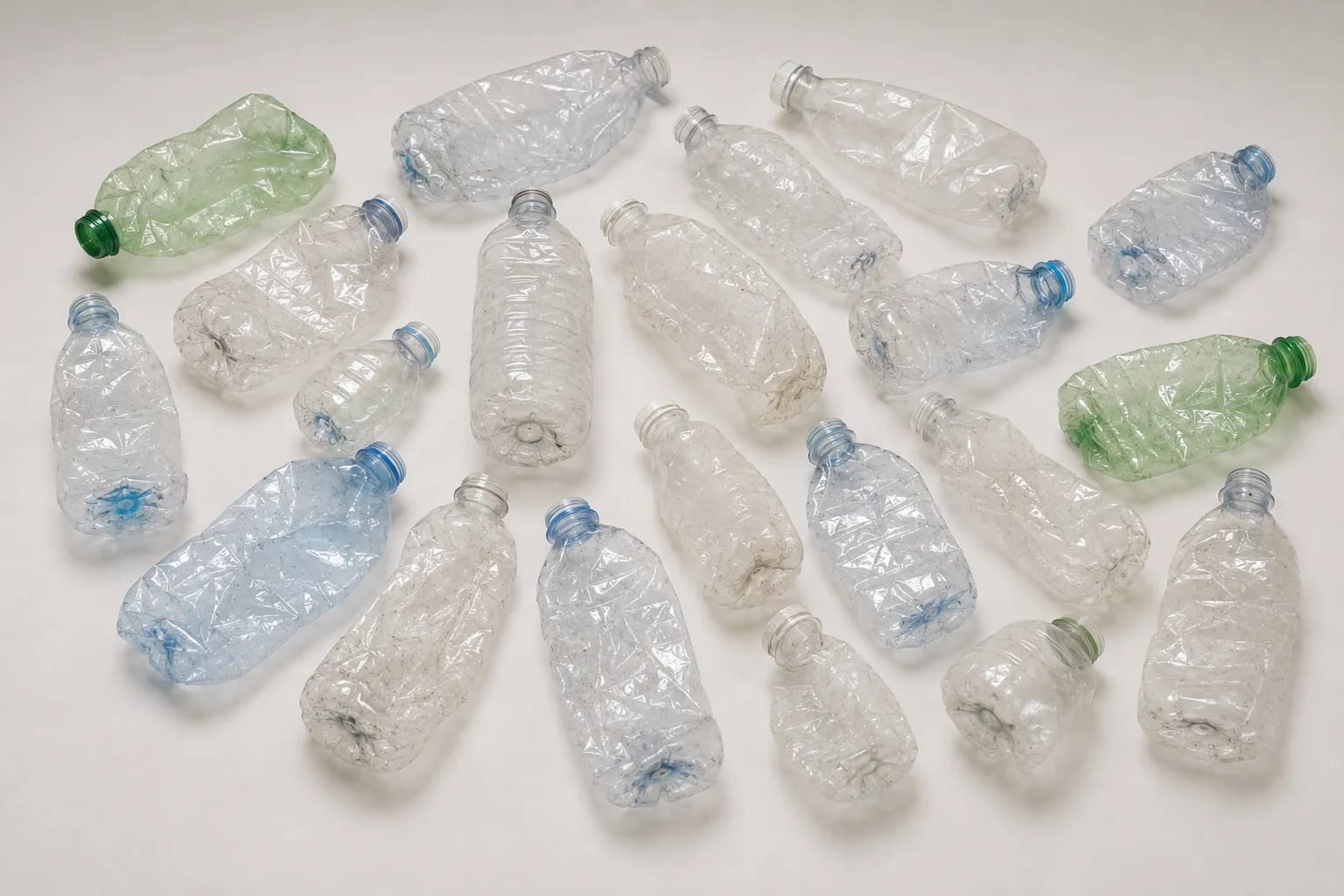
Recovering a clean PET bottle stream from mixed intake.
Mixed feed
Incoming whole bottles — PET mixed with non-PET, labeled, capped and compressed examples.
Accepted and reject classes are always confirmed on your representative samples before a configuration is quoted.
The platform
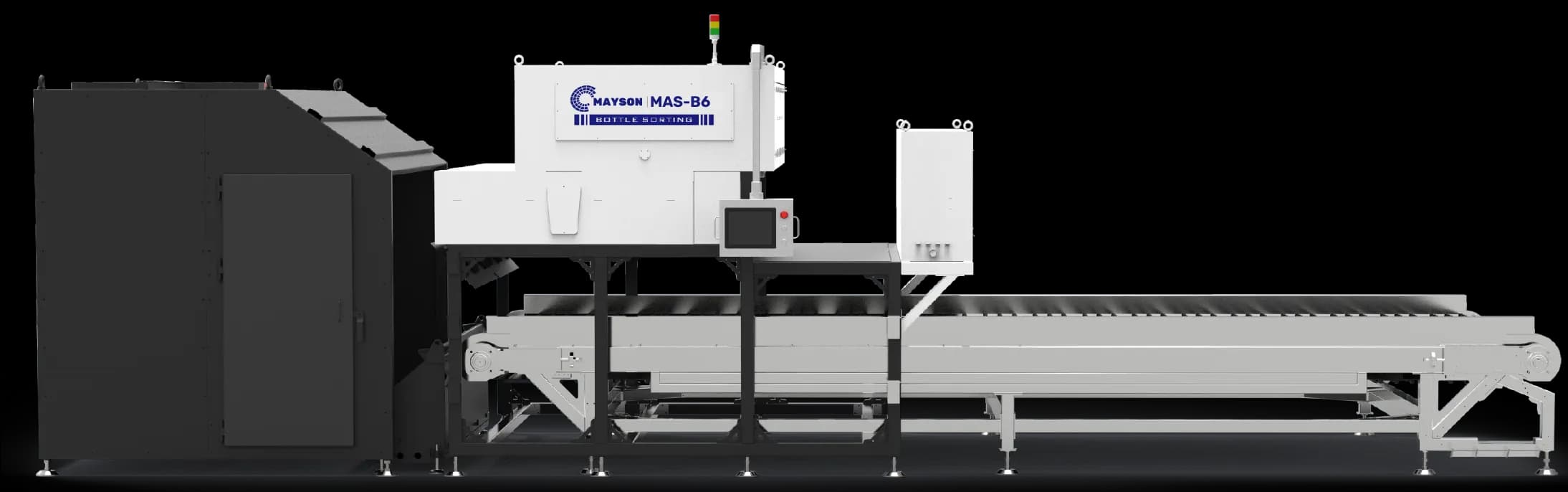
A whole-bottle sorting platform that fits ahead of shredding.
Consistent bottle singulation, class-aware inspection and reliable diversion are tuned to the bottle classes you confirm in testing.
Whole bottlesBefore size reduction
Class-awareColor, appearance & condition
Sample-ledBuilt from your bottles
Line-readyPlanned around your handoff
How it works
Bottle sorting needs spacing and line context.
The workflow should not be described as a generic flake sorter because bottle presentation drives the decision.
- 01Customer-prepared
Open & feed bottles
Baled or loose bottles are opened, metered and fed onto the line. Compression level and dirt set how well each bottle can present to the inspection zone.
- 02Singulation
Singulate & present
Bottles are spaced and oriented so each one is seen individually, with labels, caps and deformation in view rather than overlapping in a pile.
- 03Bottle inspection
Inspect the bottle class
Each bottle is read for color, material direction, label coverage and shape against the bottle classes you defined for the project.
- 04Accept / reject
Decide against your samples
Bottles are matched to the accepted and off-class examples from your real stream, including the difficult labeled, capped and crushed cases.
- 05Diversion
Divert & route
Off-class bottles are diverted to reject; accepted bottle classes continue toward shredding, washing and flake preparation on the right downstream path.
Compare
Whole-bottle sorting vs flake sorting: which do you need?
MAS-B sorts complete bottles before shredding, while flake sorters work after crushing and washing. Match your process stage to the right platform — confirmed on a representative sample.
| Your sorting need | Recommended platform |
|---|---|
| Sort whole bottles by color / appearance before shredding | MAS-B |
| Separate mixed-material whole bottles (PET / HDPE / PP / PE) | MAS-B Promaterial recognition |
| Color-sort prepared flakes after crushing | MAS-C |
| Purify PET flakes (remove non-PET) | MAS-P |
| Material + color flake sorting in one machine | MAS-PCor MAS-PC Pro for hard polymers |
| Separate PP / PE / ABS flake streams | MAS 3D |
MAS-B vs MAS-B Pro: standard MAS-B sorts whole bottles by color and AI-recognized appearance (shape, label, brand). MAS-B Pro adds NIR material recognition, so mixed-material bottle streams — PET, HDPE, PP, PE, PVC, PS — can be separated by polymer before shredding. Material recognition is available in Pro configurations.
Technical details
MAS-B bottle sorter specifications.
The MAS-B platform scales by bottle lane width and Pro configuration for whole-bottle sorting before shredding.
| Module (channels) | Length (mm) | Width (mm) | Height (mm) | Weight (kg) | Power (kW) | Capacity (T/H) | Air (m3/min) |
|---|---|---|---|---|---|---|---|
| B2 | 9600 | 2000 | 2385 | 2250 | 7 | 1.5-2 | 3.5 |
| B2 Pro | 9600 | 2000 | 2385 | 2350 | 10 | 1.5-2 | 3.5 |
| B4 | 9600 | 2900 | 2900 | 4000 | 7.5 | 3-4 | 6.5 |
| B4 Pro | 9600 | 2900 | 2900 | 4000 | 14 | 3-4 | 6.5 |
| B6 | 9600 | 3700 | 2900 | 5000 | 12 | 4-7 | 9 |
| B6 Pro | 9600 | 3700 | 2900 | 5000 | 19.5 | 4-7 | 9 |
** Figures may vary based on contaminant rates.
Buyer questions
What buyers ask before specifying a MAS-B.
Straight answers on sorting before shredding, bottle classes, labels and deformation, and what to send for a sample review.
What can MAS-B sort?
MAS-B sorts whole plastic bottles before shredding — PET, HDPE, PP, PVC and other standard bottles of roughly 0.5–2 L — by color and AI appearance. It separates clear, blue, green and brown bottles and removes black and deformed or contaminated bottles.
Can MAS-B recognize specific brands or bottle shapes?
Yes. Its AI appearance recognition can be trained on bottle shape, size and brand features for targeted or brand-specific recovery, alongside color sorting.
Can MAS-B sort bottles by material, not just color?
Yes, with MAS-B Pro. The standard MAS-B sorts whole bottles by color and AI appearance; MAS-B Pro adds NIR polymer identification to separate PET from PP, HDPE, PVC and other bottle materials before shredding.
Is MAS-B for flakes?
No. MAS-B sorts whole bottles before size reduction. For flakes, use MAS-C (color), MAS-P (PET purification) or MAS 3D (mixed polymers).
What throughput does MAS-B run?
Roughly 1.5–2 t/h on MAS-B2, 3–4 t/h on MAS-B4 and 4–7 t/h on MAS-B6, depending on bottle mix and condition. Whole-bottle chute counts are limited to 2, 4 and 6 because bottles are bulky.
Where does MAS-B fit in a recycling line?
Before size reduction — it makes color, brand or material decisions while the bottle is still intact, so contamination is caught before it enters the flake stream.
Is MAS-B only for PET bottles?
No. MAS-B is a whole plastic bottle sorting platform for mixed bottle streams — PET, HDPE, PP, PE, PVC, PS and other complete plastic bottles. Standard MAS-B sorts by color and AI-recognized appearance, while MAS-B Pro adds NIR material recognition.
Can MAS-B sort HDPE milk or PP shampoo bottles?
Yes. MAS-B handles HDPE milk and detergent bottles, PP shampoo and cosmetic bottles and other household bottles by color and AI appearance. To separate them by material — PET vs HDPE vs PP — use MAS-B Pro, which adds NIR material recognition.
Can MAS-B sort black plastic bottles?
Yes, by appearance. MAS-B can classify and route black bottles using color and AI shape and label recognition. NIR material recognition is limited on black plastic, so black-bottle material sorting depends on sample testing.
When should I choose bottle sorting instead of flake sorting?
Sort whole bottles with MAS-B before shredding when you want to route or remove bottle classes while color, shape, label and material direction are still readable. Use flake sorting (MAS-C / MAS-P / MAS-PC) after crushing and washing for higher-purity flake purification.
Can MAS-B guarantee a fixed purity?
No. Results depend on the bottle mix, labels, caps, deformation and contamination in your real stream. A representative bottle test defines the accepted and reject classes and confirms the realistic result for your line.
Online preview
Preview your bottle stream before a machine test.
Use the visual preview to discuss likely accepted and off-class bottle streams before sending real bottles.
Preview material onlineReal sample testing
Use your own bottle stream before finalizing the sorting direction.
A MAS-B project should start from real whole bottles, including target bottles, off-class bottles, labels, caps and deformation.
Request a MAS-B test