InsightsA routine job
What happens to wood, metal, stone and paper in a plastic stream?
Direct answer
They are removed by color sorting, reliably. Wood, metal, stone, rubber and paper look clearly different from the surrounding plastic in color, brightness and surface appearance, and that visible difference is what the camera detects. The result does not depend on polymer type — a wood chip leaves an HDPE stream the same way an off-color flake does.
This is a normal request, not an edge case
Foreign objects in a plastics recycling stream are common and completely ordinary. It is worth saying plainly, because the question is often asked apologetically, as though a stream carrying wood and metal were somehow unsuitable for sorting. It is not.
The reason it works is simple. A wood chip, a metal fragment, a stone, a piece of rubber or a scrap of paper does not look like the plastic around it — not in color, not in brightness, not in surface appearance. That difference is exactly what color sorting detects.

The result does not depend on what the plastic is
Because the recognition is visual, a wood chip is removed from an HDPE flake stream the same way it is removed from a PET flake stream, and the same way an off-color plastic flake is removed. The machine is not consulting the polymer at all.
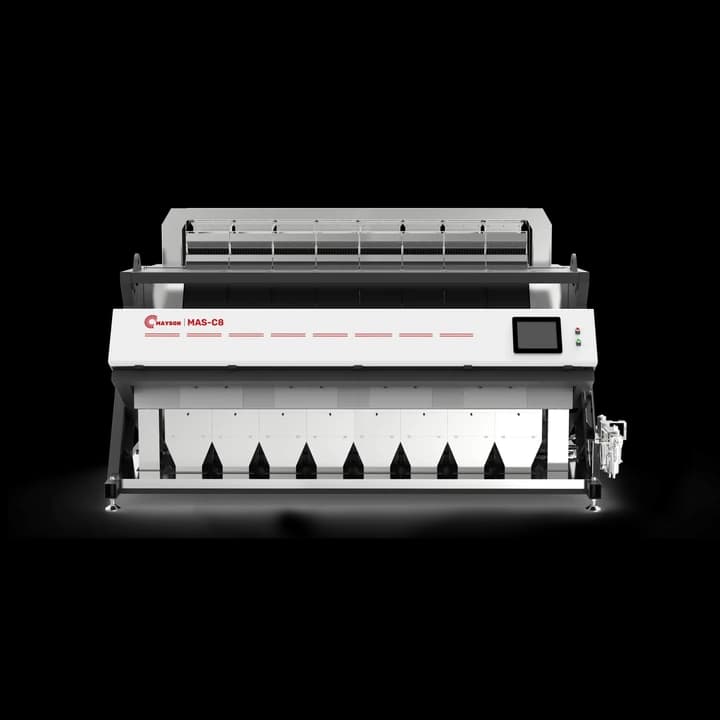
That also means this capability comes with the color stage rather than being an extra. MAS-C does it on flakes; MAS-PC and MAS-PC Pro include the same color function; MAS-B does it on whole-bottle streams.
Why NIR is the wrong tool here
NIR material recognition identifies polymers. Presenting it as a way to find wood, metal or stone gets the roles backwards: those objects are not polymers with unusual spectra, they are simply not plastic, and the property that gives them away is visible.
The practical consequence is about sequencing rather than capability. A line that needs both foreign-object removal and a polymer decision gets the first from the color stage and the second from the material stage.

Where a magnetic separator belongs
When a feed carries a large amount of ferrous metal, a magnetic separator ahead of the sorter is standard line practice. This is a line-design suggestion, not a limitation of the sorter: it lets the sorter concentrate on the fine separation instead of spending ejections on material a magnet removes for free.
Pre-sorting more broadly — manual checks, screening, magnets — is normally customer or third-party equipment, upstream of the optical stage.
Where this stops applying
- Foreign-object removal is a color decision. It says nothing about the polymer identity of anything in the stream.
- NIR is not the route to finding wood, metal, stone or other non-plastic objects.
- A magnetic separator ahead of the sorter is a line-design suggestion for heavily ferrous feed, not a requirement and not a limitation.
- The material form still decides the platform: whole bottles and rigid flakes are handled by different machines, and film and pellets by neither.
- The actual reject-removal level on your stream is confirmed by a sample test, not assumed from the contaminant list.
Common follow-ups
Can an optical sorter remove wood and metal from plastic flakes?
Yes, and it is a routine job rather than a special case. Wood, metal, stone, rubber and paper look clearly different from the plastic around them in color, brightness and surface appearance, which is what the sorter detects.
Does it matter which plastic the contaminants are mixed into?
No. The recognition is visual, so a wood chip is removed from an HDPE stream the same way it is removed from a PET stream. Polymer type is not part of that decision.
Should NIR be used to find foreign objects?
No. NIR identifies polymer type. Foreign objects are found by color sorting, because the property that distinguishes them is visible rather than spectral.
Do I need a magnetic separator as well?
If the feed carries a large amount of ferrous metal, a magnet ahead of the sorter is standard line practice, because it lets the sorter concentrate on the fine separation. It is a line-design suggestion, not a limitation of the machine.
Which platform does foreign-object removal?
The colour stage: MAS-C on flakes, MAS-B on whole bottles, and the color function inside MAS-PC and MAS-PC Pro.